
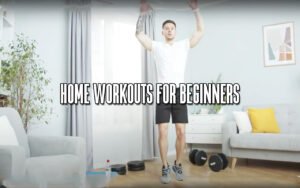
If you want to do bodyweight workouts at your home. Here, we show you some of the best bodyweight workouts that you can do at home. Even if your home gym is currently lacking weights (or there isn’t enough space or gear in your house to come close to calling it a workout area), there’s no need to worry.
If the fitness world has shown us anything in the last year, it’s that you may get a comprehensive whole-body workout with only your body weight.
Bodyweight workouts exercises aren’t only used as a last resort.
Equipment-free training is a popular method for both minimalists and serious athletes since it may be used to work your muscles with both easy and challenging exercises that rely solely on your body and gravity. No-gear exercises can target almost every muscle group and push them to their limits, from your legs to your core to your chest.
We’ve put up a 5-move routine that will work your core, arms, chest, and back without the use of a kettlebell or dumbbell. A mat and a little space are all you need to start sweating and building muscle.
HOW OFTEN DO YOU WORK OUT IN THE GYM?
The Bodyweight Workouts
Perform each exercise for the specified period, with little resting in between. Repeat for 4 to 5 rounds.
1. Plank
45 to 60 seconds
“The plank is one of the finest bodyweight workouts you can do since it involves your entire core, glutes, back, and abs,” says Men’s Health fitness director Ebenezer Samuel, C.S.C.S., about this exercise. A plank is a full-body exercise that involves tension from your arms to your feet.
You need a flat back with your core and glutes squeezed for a good plank. Pick up your body by drawing your belly button into your spine. To keep your back tight, contract your lats and rhomboids. Your elbows should be positioned stacked right underneath your shoulders in a level posture, with your head in a neutral position.
2. Hollow Hold
45 to 60 seconds
The hollow hold is a fantastic exercise to strengthen your core and improve posture.
Consider pushing your lower back into the floor as you drive your upper body down to squeeze a bug between them—there should be no space. Flex your abs to do it. At this point, raise your legs 2 to 3 inches above the ground. Extend your arms in front of your head. To enhance, bring your arms in front of you and tuck in your knees as you continue to press your back into the ground.
3. Pushup
15 to 20 reps
The pushup is a movement you’ve been performing since grade three, but your form may still need some work.
Begin in a pushup position. Squeeze your glutes and core in a straight line. Place your hands slightly behind your shoulders and screw them into the ground to create a slight external rotation. Your neutral neck should be straightforward. As you come down, squeeze your shoulder blades and keep your elbows near your torso to form a 45-degree angle. Pull it back up.
If you have to change it, do so on a workbench rather than getting down on your knees to remove some strain.
4. Bird Dog
8 to 10 reps on each side
The bird dog may be the most underappreciated fundamental exercise.
Make sure your shoulders are stacked directly beneath your wrists when you start on all fours. Create a broad base by placing your knees on the same level as your wrists. Look at the ground in a balanced posture.
Start by squeezing your abs, then squeeze your shoulder blades to generate a tiny bit of tension. Extend your right arm as far out as possible, with your thumb facing upward. Bring your arms down to the ground and repeat on the other side.
Then, using your legs the same way, extend your right foot as far back as possible and squeeze through your glutes to maintain balance.
Keep your hips and shoulders level with the ground. Raise your right arm and left leg, and keep them raised for 1 to 2 seconds. Repeat both arms and legs from left to right. Alternating is a good idea.
5. Superman Hold
30 seconds
The superman hold is a bodyweight back exercise that you may do anywhere.
Put your belly on the ground and keep your head neutral, not raised. Squeeze your glutes, and your feet should immediately rise off the ground. Extend your shoulders as far ahead of you as possible and squeeze your shoulder blades. Raise your shoulders up and forward, stretching them as far as you can in front of you. Take your time and hold it for 1 to 2 seconds. Feel this in your glutes and mid-back.
6. Air Squats
How to do it: Begin by standing shoulder-width apart your feet. Sit back in a chair and lower your hips as if sitting down. Lower your body as low as possible without causing a natural curve in your lower back. To get back up, walk your feet backward. Could you do it again?
Form tip: Consider pushing the floor away as you stand up, maintaining your weight in your heels. Make sure your chest is held high and that your core stays taut. Feel how your entire lower body and abs are working.
Turn it down: If you are new to squats, consider performing them in front of your sofa or a chair. Tap the chair at the bottom with your butt, then stand up straight.
Turn it up: Make things more difficult by increasing the speed. Make sure you maintain good form as you go faster and still drop it low—don’t abbreviate the moves.
How to do it: Stand a little more than a leg’s length in front of a bench, chair, box, or sofa. Put your right foot at the top of the bench behind you. Put every bit of weight on your left heel on the floor. Bend your left knee and lower down until your back knee comes to the floor or your front leg bends 90 degrees. Drive through a front left foot to stand back up. Repeat.
Form tip: Make sure to work your core throughout the entire movement, and push through your front foot’s heel and big toe as you stand up—as though you’re pushing the floor away from you. By the last rep, your glutes and quads should be on fire.
Turn it down: When performing this move, which challenges the legs, glutes, and feet while also requiring good balance, keep it simple if necessary—go as low as you can.
Turn it up: By lowering down, coming up halfway, then lowering back down before standing up to the top, you’ll be able to add a half rep.
8. Mountain Climbers
How to perform it: Start in a plank position, with your shoulders over your wrists, making a straight line from shoulder to heel. As you come down, keep your form solid as you drive one leg toward your chest, then quickly return to plank. Then, quickly step back to plank and push the other leg toward your chest. Alternate as soon as possible.
Form tip: Keep your shoulders over your wrists, and don’t let your hips pike up or drop as you push the floor away with your upper body to maintain a solid foundation of support. Increase the speed of your run to improve your heart rate, but keep your form in check.
Turn it down: If you need to keep a solid plank, keep it slow.
Turn it up: Pick up the pace, looking like you’re sprinting in plank position.
9. Pistol Squat
How to do it: Stand up with your feet more than shoulder-width apart and toes facing forward. Move your weight to right foot and flex your left foot, then extend your left leg in front of you with the heel a few inches off the ground. Squeeze your quadriceps, hips, glutes, and upper back with your core braced. Sit back into a squat. As you descend, raise your arms in front of you for counterweight and stay with a mild forward lean. Raise your body as high as possible, keeping tension in your muscles, then drive your right foot to stand up. Repeat this process on the other side. If you’re working on the move, you may always perform it on a chair, bench, or sofa (as shown).
Form tip: Keep your knee in line with the second toe (the one next to your big toe). Apply pressure to the heel of the standing leg, as well as the big toe and pinky toe. Consider your foot to be a three-legged tripod.
Turn it down: Have you yet been able to master a two-legged squat? Continue with the technique on two legs. Alternatively, if that’s something you can do, begin by sitting on a tall chair, bench, box, or sofa with one foot planted and the other extended in front of you a few inches off the floor. Extend your arms in front of you. To stand up, lift your leg and push your hands down to the floor as you lean back and rock forward. Ensure your weight isn’t focused on the ball of the foot. Lower Back to the chair and go through it again. When you’ve completed the second level, remove the rocking.
Turn it up: If you have a pistol, squat down—and you can return to a standing position—and grasp some weight, such as dumbbells if you have them. You can also slow down the movement and concentrate on control as you lower and stand up.
10. Plank Up-Downs
How to do it:
- Take a plank position, with your shoulders over your wrists, making a straight line from your shoulders to your feet—lower one arm to the ground, shoulder over the elbow, and then the other.
- Place one palm back on the floor, arm outstretched, and then the other.
- Continue alternating.
Form tip: Keep your shoulders over your wrists and elbows the entire time—your hands are only switching positions with those on either side. Also, keep your hips aligned with your shoulders—don’t pike them up or drop them down. Your abs and shoulders should be working hard, but don’t forget to squeeze your glutes and activate your legs.
Turn it down: To finish the exercise, place your knees on the ground in a modified plank stance.
Turn it up: Raise the speed as much as possible without compromising form. If you’re feeling unstable, you may also try putting a little pillow or yoga block on your back and ensuring it doesn’t fall.
11. Alternating Side Lunge
How to perform it: Stand with your feet about shoulder-width apart and toes turned forward. Now extend your right foot out to the three o’clock position. Sit with your butt back and bend your right knee as you lower down, keeping your left leg straight. To get back to standing, walk out of the correct heel. Begin on the left side and work your way across, repeating each side.
Form tip: As you enter the lunge, maintain a neutral spine and focus most of your weight on your heel. Consider lowering into the lunge with your hips straight back and your backside against a chair at the back of you—you want your hips to go straight back as you lower. Don’t push your weight to the side even if you’re stepping in that direction.
Turn it down: Don’t go as low in the lunge to make it more approachable.
Turn it up: Keep your foot on the same side and add a hop at the top of the move, pushing your knee toward your chest. Try skaters who hop from side to side as they remain low in a lunge stance.
12. V-Up
How to do it: Lie face-up on the floor, with your legs extended straight ahead and your arms outstretched overhead. Please continue lifting your torso and legs into a V shape as you bring your arms down parallel to the floor. Slowly return to the ground. Repeat.
Form tip: Try to reach up to your tailbone, like in a yoga boat posture. Sit nice and tall at the top. To add more fire to your abs, maintain control of your movement as you lower yourself back to the ground.
Turn it down: Instead of maintaining a straight position throughout the entire exercise, bend your legs at the top, bringing them to a tabletop posture.
Turn it up: Hold the movement’s V form for 10 seconds and carefully lower it before repeating.
13. Burpees
How to do it: Make sure you’re standing. Then, squat down and place your hands beneath your shoulders. Then jump back down to the top of a push-up position with your feet. Push your legs all the way down to the floor and then lift them back up again. Instantly jump your feet back up to your hands. Jump up, clapping hands overhead into the air as you drive your heels up and jump straight up. Land softly. Repeat.
Form tip: The key to a nice burpee is maintaining a tight core and a neutral spine position, not arching or curving your back. This is a full-body exercise!
Turn it down: Eliminate the jumps. Backward and forward in the burpee, but instead of a hop, come to your toes at the top. You may also elevate your chest off the ground by performing a plank at the bottom of the move.
Turn it up: Go for quickness without compromising form. You’ll put your strength and, more significantly, your cardio endurance to the test.
Turn these bodyweight workouts into a strength workout.
Warm-up before you get started with dynamic stretches. Perform each move for 30 seconds, keeping excellent form and only resting when necessary. After the final exercise, take a break for 45-60 seconds. Repeat down for three to four rounds.
THE 16 BEST PULL-UP BARS FOR HOME WORKOUTS
BEST EXERCISES FOR LOSE BELLY FAT AT HOME
THE TOP 20 BEST INDOOR ROWING MACHINES FOR YOUR HOME GYM
50 PIECES OF WORKOUT EQUIPMENT YOU NEED FOR YOUR HOME GYM IN 2022
You May Also Like

Best Door Gym
January 11, 2025
The Best 16 Weight Benches For Your Home Gym in 2024
August 2, 2024


Blog Comments
Proper Way to Do a Jump Squat - Home Workout Reviews
March 25, 2022 at 12:29 pm
[…] BODYWEIGHT WORKOUTS THAT YOU CAN DO AT HOME […]