
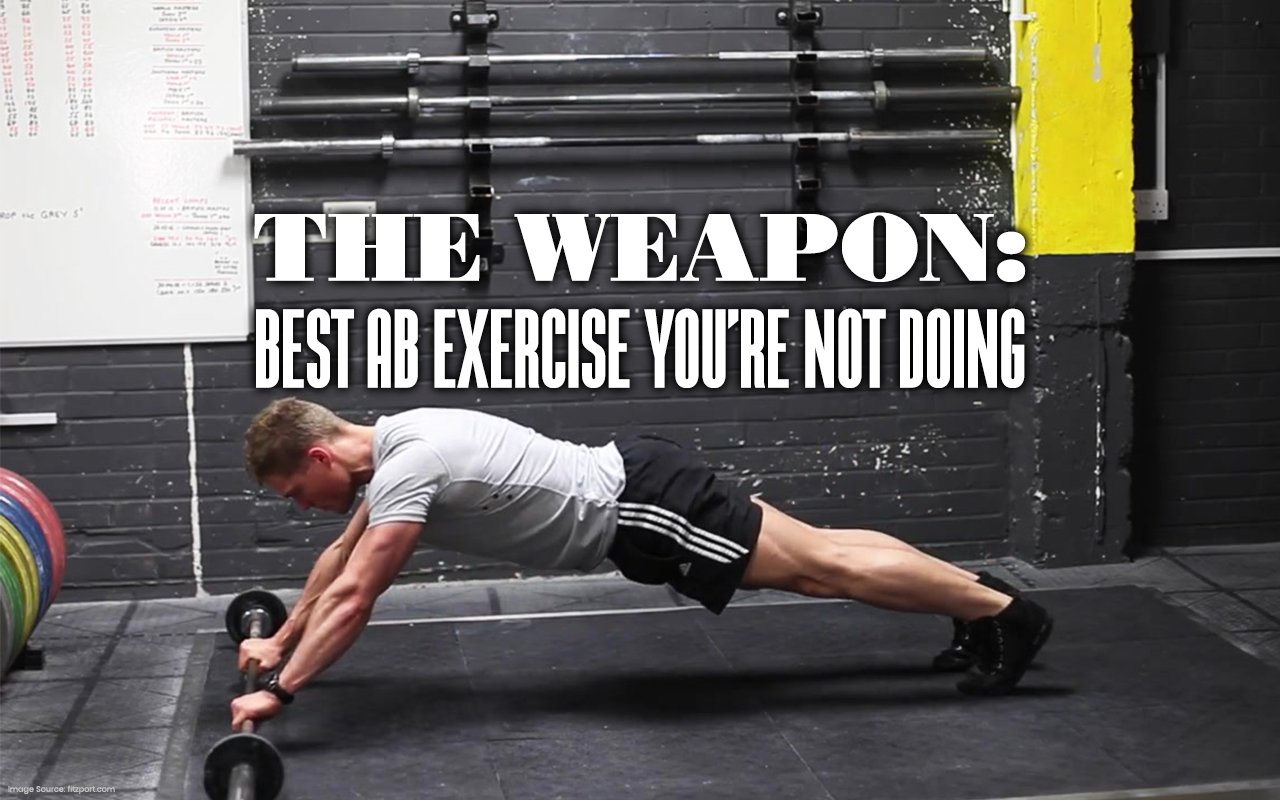
This Ab Exercise will help you develop a stronger core that you’ve probably never heard of before. Learn how to do the weapon Ab exercise and why you should. The problem with core training in today’s fitness industry is that there isn’t enough. The majority of individuals wind up doing the monotonous, useless training method that may be boring and might ultimately deter one from continuing. What’s worse- When you can maintain a 20-minute plank for an extended period of time, it has little carryover to other activities in life. Who cares?
In reality, we must remember that the core includes the abs, obliques, and lower back. When training it for health and strength and testing its abilities, it’s critical to distinguish between them. However, as long as we choose functional movements to deal with all the factors mentioned above and protect the spine, they should be.
The fundamental functions of the core are as follows:
- Trunk flexion and extension (think sit-ups and back extensions)
- Rotation and anti-rotation (anything that twists or avoids twisting)
- (Ant-extension) (Maintaining a proper spinal alignment and avoiding an overarch.)
The long and short of it is that planking, and leg raises are just the beginning of what you can do to train your core effectively, and a lack of exploration is often why people get bored with doing so.
The Problem with Ab Wheel Rollouts
One of my favorite core Ab exercise to focus on the abs anti-extension capacity is the traditional ab wheel rollout (which, I believe, is the most undertrained component of core strength). But there’s a caveat–they’re very advanced. Many typical lifters cannot accomplish these, much alone with good form.
Rather than restricting the range of motion until you’re only moving a few inches each way, it’s worth changing the sequence ultimately to allow for the intended ROM. Lifting toes that don’t have anti-roll technology is a big mistake for 80% of lifters. Rollouts from the knees might alleviate the problem, but they can also produce the same issues on a lesser level.
The solution is to practice bracing more effectively while allowing time to go through a full-body extension. Doing some things before you finish the article would be best to ensure it works well for your audience.
Get Good at Hand Walkouts!
The main difference between a walkout and a rollout is that the former is a fantastic technique to train anti-extension trunk strength in a less dangerous way than ordinary rollouts. The second advantage is that they develop the body’s adaptation to horizontal anti-extension through their toes rather than their knees. This is a critical component in the development of an athlete’s strength. It can help someone break muscular strength plateaus that are movement specific. You can also choose your extension distance and safely push your limits without risking your lower back’s ROM escaping you and causing damage.
Enter the Weapon
The technical name for it would most likely be something like “banded barbell rollout from bear stance,” but I like to call it a weapon, mainly because it is, in fact, a hidden weapon that you can add to your arsenal. It also resembles a medieval torture device, ready for use. Rather than attempting to explain this movement in detail ahead of time, take a look at it here and respond below:
To begin, here are a few coaching instructions:
- Keep the body low- The less you can “pike” at any of the stages of this movement, the better. Keep the knees a few inches above the ground at all times, and you’ll have a better chance of achieving your aim.
- Aim for a full extension at the elbows- When you’re in the finish position of your lift, your arms shouldn’t be bent.
- Use both halves of the body- As you roll the bar away from you, your lower body should push just as much as your upper body. Keep your elbows straight as you move the bar into your start position, but make careful to bend them.
- Don’t forget- The bands provide assistance and resistance, depending on the portion of the lift we’re discussing. Choose a band thickness that enables you to execute the lift properly and receive all the advantages.
This move is essentially an ab wheel rollout from the toes, with the bonus of a horizontal push press and a built-in safety mechanism for the latest ranges. All of this is why I’m so passionate about the movement. The toe loop design allows for a full extension rollout from the toes since, at complete extension, someone will stretch the band entirely and be ready to assist you back into your starting posture (preventing you from losing form and collapsing). At the same time, this lift’s “press” component is a test of resistance for that band, which serves as a barrier to the arms reaching their lockout.
A wider hand posture may benefit beginners because they won’t travel as far. Bring your hands and feet closer as you become more comfortable and confident with the dance.
One more thing
Remember to use the correct head position. The head should follow the torso, just like any other Ab exercise. During horizontal patterns, looking up is appealing since it puts a little strain on the cervical spine. Furthermore, because there is an overhead component to this lift, cervical alignment is that much more critical.
Summary
This is an excellent tool for overall strength, core power, and a supercharged variation of the ab wheel rollout from the toes – particularly for big, strong lifters and tall people with long extremities. The ab wheel movement may be beyond their capabilities in both situations—at least not yet. Put this movement to work for you, and you’ll be able to reap all the advantages as well as some. Even if you don’t feel like your strict press is getting any better, bear in mind that it might.
You May Also Like
Exercises to get a Bigger Butt
December 2, 2024
Parent-Child Home Workouts Routines
December 13, 2023

Blog Comments
The Conditioning Comeback: 8-Week Total Body Fitness Workout
August 9, 2022 at 11:27 am
[…] The Weapon: Best Ab Exercise You’re Not Doing […]